Leaking when you laugh, sneeze, or work out? Why it happens and what helps
Bladder leakage is common, especially after having kids and around menopause. It's also treatable. Here's what's behind it and the options worth knowing about.


You cross your legs before you sneeze. You skip the trampoline at your kid's birthday party. You know where every bathroom is before you leave the house, and you've started wearing a liner "just in case."
If that sounds familiar, you're far from alone. Studies estimate that 25% to 45% of women have some degree of urinary leakage.1 It's common enough that many women assume it's just part of having kids or getting older. It's common, but it's not something you have to put up with.
What stress urinary incontinence is
Leaking when you laugh, cough, sneeze, jump, or lift something heavy has a name: stress urinary incontinence. "Stress" here means physical pressure, not emotional stress. When pressure in your abdomen rises suddenly, the muscles and tissues that support your bladder and urethra can't hold everything closed, and a little urine escapes.
It's different from urge incontinence, which is a sudden, strong need to go that's hard to hold. Many women have a mix of both, which is one reason a proper evaluation matters.2
Why it happens
Your pelvic floor is a group of muscles that supports your bladder, uterus, and bowel, a bit like a hammock. Several things can weaken or stretch it:
- Pregnancy and childbirth. In a large Norwegian study, women who had given birth vaginally were more likely to have stress incontinence than women who hadn’t given birth.3
- Perimenopause and menopause. As estrogen declines, the tissues around the urethra and vagina get thinner and less elastic, which can affect bladder control.4
- Extra weight. More weight means more pressure on the pelvic floor. In one clinical trial, women who lost weight had significantly fewer leakage episodes.5
- Chronic pressure. A long-term cough, constipation, or years of heavy lifting all put repeated strain on the same muscles.
Bladder leakage is common. That doesn't make it something you have to live with.
Your options
The right approach depends on what's causing your leakage, how often it happens, and what you want to get back to. Common options include:
- Pelvic floor muscle training. Exercises that strengthen the pelvic floor, often guided by a pelvic floor physical therapist. Clinical guidelines recommend it as a first-line treatment for stress incontinence.2,6
- Addressing hormones. For women in perimenopause or menopause, supporting estrogen levels can help the tissues that support bladder control.4
- Lifestyle changes. Managing weight, treating constipation, and adjusting fluids and caffeine can all reduce pressure on the bladder.
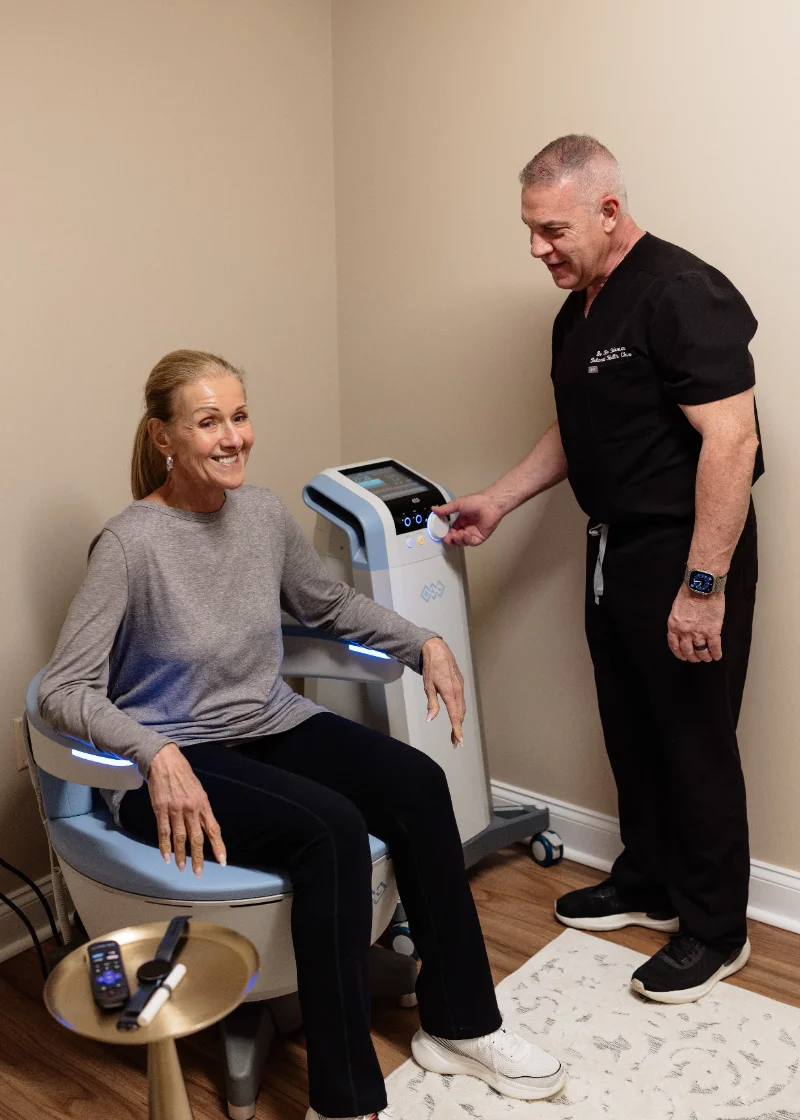
Emsella. An FDA-cleared chair that uses high-intensity focused electromagnetic energy to stimulate thousands of pelvic floor contractions while you sit fully clothed.7 Many women use it alongside pelvic floor exercises.
These aren't either/or choices. Many women do best with a combination.
How we look at pelvic health
At Balanced Health, we look at the whole picture: your history, your hormones, your core and pelvic floor, and what's getting in the way of your daily life. Across all of our care, we focus on optimal function, where your body feels and works its best, not just the absence of a diagnosis.
From there, we build a plan with you. That might include Emsella treatment here in our office, hormone support, lifestyle changes, or a combination, and we adjust as your body responds.
What you can do next
- For a few days, note when leakage happens: laughing, coughing, exercise, or a sudden urge. It helps tell the types apart.
- Notice whether it started or changed after pregnancy or around perimenopause.
- Bring it up with your provider. It’s one of the most common things we hear about, and it’s never an awkward question here.
You can learn how we approach intimate and pelvic health, or book a free discovery call to talk it through. We see patients in person in Hammonton and virtually anywhere in New Jersey.
Founder of Balanced Health and a Georgetown University–trained women's health nurse practitioner with 25+ years in medicine and advanced training in functional medicine.
Meet our teamSources
- Milsom I, Gyhagen M. The prevalence of urinary incontinence. Climacteric. 2019;22(3):217–222.
- American College of Obstetricians and Gynecologists. Practice Bulletin No. 155: Urinary incontinence in women. Obstet Gynecol. 2015;126(5):e66–e81.
- Rortveit G, Daltveit AK, Hannestad YS, Hunskaar S. Urinary incontinence after vaginal delivery or cesarean section. N Engl J Med. 2003;348(10):900–907.
- Portman DJ, Gass ML. Genitourinary syndrome of menopause: new terminology for vulvovaginal atrophy. Menopause. 2014;21(10):1063–1068.
- Subak LL, Wing R, West DS, et al. Weight loss to treat urinary incontinence in overweight and obese women. N Engl J Med. 2009;360(5):481–490.
- Dumoulin C, Cacciari LP, Hay-Smith EJC. Pelvic floor muscle training versus no treatment, or inactive control treatments, for urinary incontinence in women. Cochrane Database Syst Rev. 2018;10:CD005654.
- Samuels JB, Pezzella A, Berenholz J, Alinsod R. Safety and efficacy of a non-invasive high-intensity focused electromagnetic field (HIFEM) device for treatment of urinary incontinence and enhancement of quality of life. Lasers Surg Med. 2019;51(9):760–766.
This article is for education only and isn't medical advice. Talk with your provider before starting or changing any treatment.